

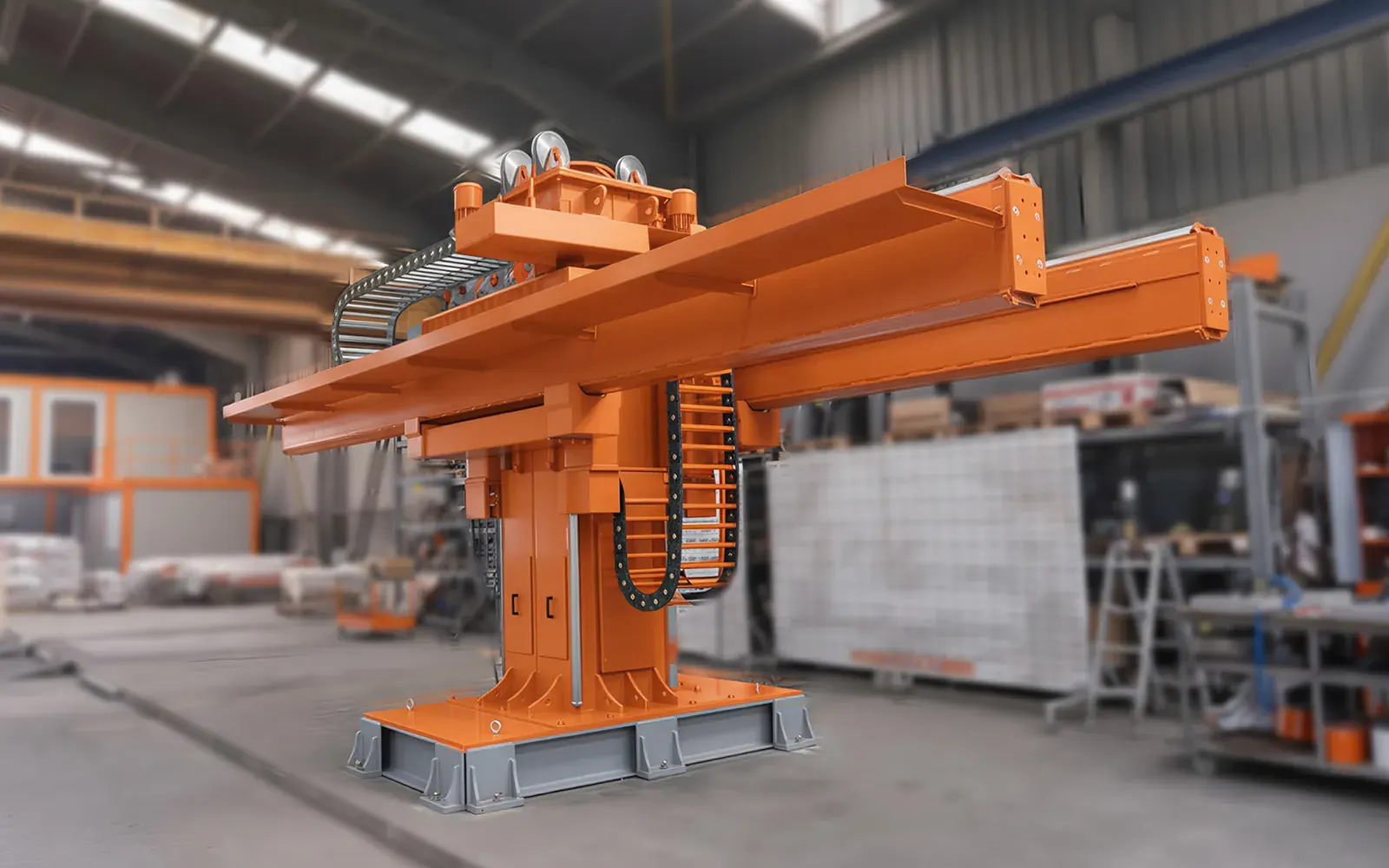
On large-diameter, thick-walled parts such as tanks, pressure vessels, pipes and wind towers, the most time-consuming work is the longitudinal and circumferential seams that run for metres. For these seams, submerged arc welding (SAW) is often the most productive method; however, its productivity only materialises when the welding head is held steady, at the right angle and free of vibration along the whole seam. A column boom does exactly this: it positions the welding head over the part and carries it along the seam in a controlled way.
In this article we look at how submerged arc welding is set up with a column boom, which factors determine speed and penetration, and what needs to be clarified before investing.
Why is submerged arc welding planned together with a column boom?
In submerged arc welding, the arc forms beneath a layer of granular flux. Because the arc is not visible, there is almost no spatter or arc light; and since high currents can be used, deep penetration and high deposition rates are achieved. These advantages come with one condition: the flux must rest on a horizontal surface to cover the weld zone. For this reason, submerged arc welding is largely carried out in the flat position.
Welding a large cylindrical part manually in the flat position is not practical. The solution is to split the task in two: the part rotates or stays still on a tank roller, while the welding head waits at the right point at the tip of the column boom or travels along the boom. On a circumferential seam the part rotates and the torch stays still; on a longitudinal seam the boom moves the head along the seam.
Factors that determine speed and penetration
In submerged arc welding with a column boom, the result does not depend on a single parameter. The following points together determine both welding speed and the repeatability of penetration.
Torch position and boom rigidity
On long seams, the position of the welding head relative to the seam axis matters to the millimetre. As the boom gets longer, deflection and vibration at the tip increase, which affects seam tracking and penetration depth. For this reason, the equipment carried at the boom tip (welding head, wire reel, flux hopper and camera, for example) should be taken into account when selecting the system.
Number of wires: single wire, tandem and tandem twin
Single-wire systems are sufficient for many applications. For very thick-walled parts, tandem or tandem twin arrangements, in which more than one wire works in the same weld pool, are preferred to increase the weld metal deposited per unit of time. 2K Welding's Heavy Duty column boom series is designed for this type of application.
Flux handling
In submerged arc welding, feeding the flux, collecting it after welding and reusing it affect both cost and quality. Because flux that has absorbed moisture can increase the risk of porosity, keeping the flux dry is important. Flux recovery, heating and recirculation equipment can be added to column boom systems as options.
Synchronised operation with the roller
On a circumferential seam, the welding speed is set by the rotation speed of the part. If the roller speed fluctuates, seam width and penetration change too. For this reason, the column boom and the tank roller should be planned to work in sync within the same control logic.
Column boom series and typical applications
2K Welding column booms are offered in three series. The information below is taken from the 2K Welding product page; detailed values for each model are given in the technical data sheet of each series.
| Series | Typical applications | Boom tip load capacity |
|---|---|---|
| Sensitive (SMD) | Precision welding processes such as TIG, ForceTIG, plasma and K-TIG | 200–220 kg |
| Medium Duty (MD) | Pressure vessels, stainless steel tanks and pipes | 220 kg |
| Heavy Duty (HD) | Tandem / tandem twin submerged arc welding on wind towers and thick-walled parts | 425 kg |
On the column side, fixed, 360° rotating and rail-mounted travelling options are available. A rail-mounted column provides flexibility for long parts or layouts where more than one workstation must be served.
Root and fill passes with a double-sided boom
In thick-walled joints, the root pass and the fill and cap passes have different requirements. The column boom can be equipped on both sides: while a gas metal arc (MIG/MAG) head at one end lays the root pass, the submerged arc head at the other end can carry out the fill and cap passes. This way, several passes can be completed with the same set-up, without moving the part to another station.
Repeatable quality: recording the parameters
On long seams, recording parameters such as current, voltage, welding speed and wire feed is as important as keeping them constant. In certified fabrication such as pressure vessels in particular, compliance with the welding procedure specification (WPS) must be demonstrated. 2K Welding's OPR single-point control system offers one panel for arc control, management of peripheral units such as rollers and positioners, and recording of WPS parameters, and can be used as an option on column booms.
What to clarify before investing
- Part range: the smallest and largest diameter, length and weight to be welded.
- Wall thickness and joint preparation: the thickness range, groove shape and required number of passes.
- Column height: the largest part diameter and the crane hook height in the plant.
- Column type: the need for a fixed, 360° rotating or rail-mounted travelling column.
- Process: set-ups such as single wire, tandem or a double-sided boom.
- Existing equipment: the capacity of the rollers and positioners in use and the need for synchronised operation.
Consider a hypothetical example: a company producing stainless steel tanks currently welds circumferential seams manually, and the long fill passes on each tank create a bottleneck. In this case, the right set-up is determined by evaluating tank diameter, wall thickness and the capacity of the existing roller together. Which series and which wire arrangement are suitable only becomes clear with this information.
Frequently asked questions
Is a column boom used only for submerged arc welding?
No. On 2K Welding column boom series, a submerged arc (SAW), MIG/MAG, TIG, ForceTIG, K-TIG or plasma welding head can be integrated at the boom tip. Submerged arc welding is one of the most commonly preferred processes for long longitudinal and circumferential seams on thick-walled parts.
How is the column height determined?
The column height is determined by the diameter of the part to be welded. Custom production is possible, also taking the crane hook height in the plant as a reference.
Can the root pass and fill passes be done with the same column boom?
Yes. The boom can be equipped on both sides; for example, with a gas metal arc (MIG/MAG) head at one end and a submerged arc (SAW) welding head at the other. This way, the root pass and fill passes can be completed with the same system.
Why is the tank roller important in submerged arc welding?
On a circumferential seam the torch stays still and the part rotates. The welding speed is therefore set by the rotation speed of the roller, and stable operation of the roller in sync with the column boom directly affects seam quality.
To evaluate the right column boom set-up for your project, you can review the column boom product page and share your part dimensions and welding requirements via the 2K Welding contact page.