

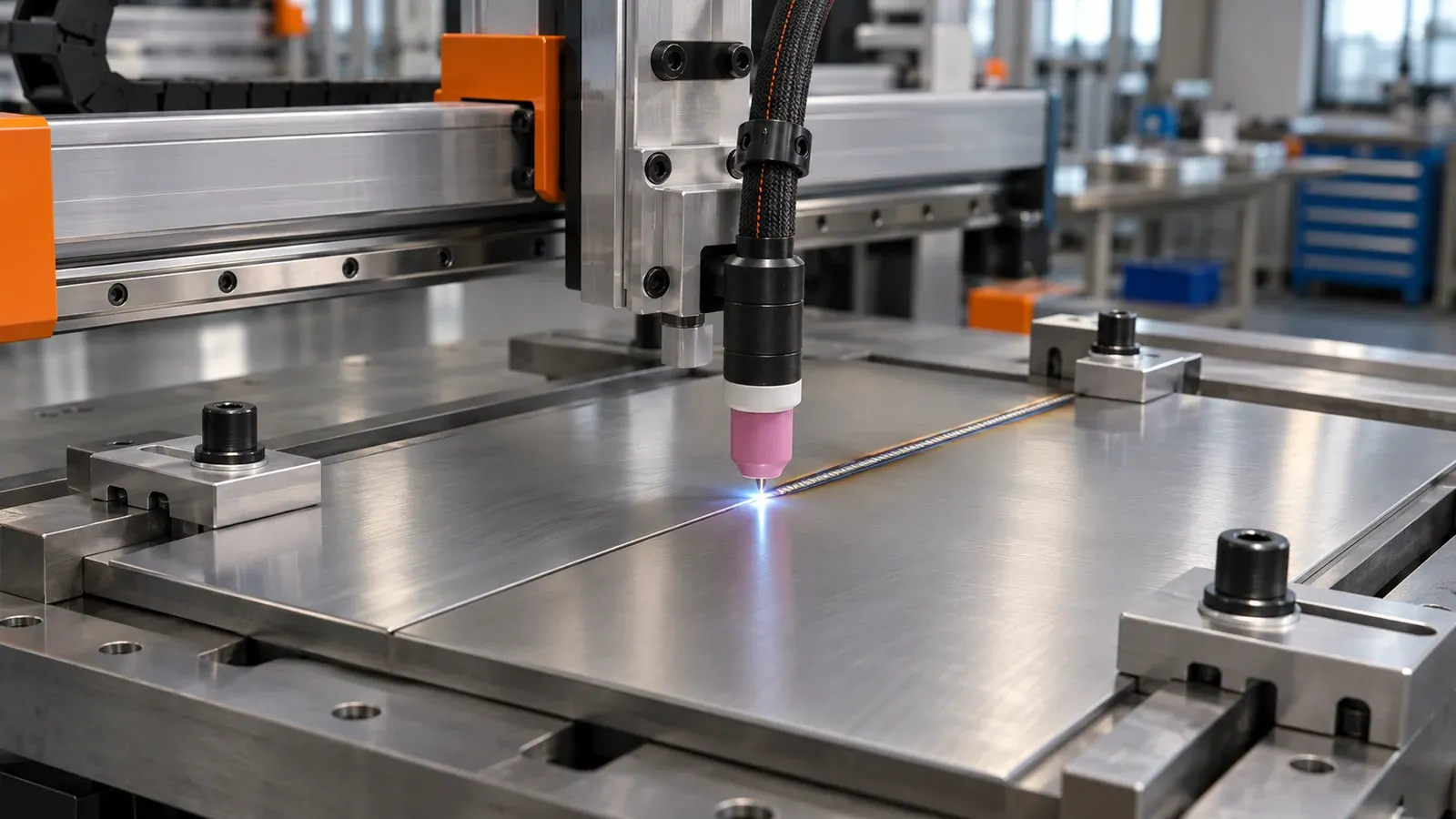
In the fabrication of thin-walled stainless steel tanks, process equipment and pipes, the most common complaint is less about the weld itself and more about what happens around it: distorted sheet, discoloured surfaces, oxidation at the root or areas burnt through here and there. The common cause of these problems is uncontrolled heat input. TIG welding, often called argon welding on the shop floor, is the preferred method for thin stainless steel; but when it is done by hand, heat input depends on the welder's travel speed and how steady their hand is. In this article we look at what determines heat control in thin stainless steel and how automation contributes to that control in argon welding.
What Is Argon Welding and Why Is It Preferred for Thin Stainless Steel?
Argon welding is a common shop-floor name for TIG (Tungsten Inert Gas) welding. The arc forms between a non-consumable tungsten electrode and the workpiece, and the weld pool is shielded from the air by argon gas. The arc is stable, there is no spatter and the current can be set precisely at low levels. These features make TIG well suited to thin-walled stainless steel parts.
The same precision also makes the method sensitive to variables. When arc length, travel speed and filler wire feed become irregular, heat input fluctuates too. A fluctuation that thick plate can tolerate turns directly into a defect on thin sheet.
Why Is Heat Control Critical in Thin Stainless Steel?
Stainless steel has lower thermal conductivity and higher thermal expansion than carbon steel. Heat builds up in the weld zone, and the sheet changes shape as it expands and cools. This effect is more pronounced in thin walls. The main problems that occur when heat control is lost are:
- Distortion: waviness, ovality and loss of dimensions in the tank shell
- Burn-through: melting of the sheet due to local overheating
- Discolouration: an oxide layer forming on the surface and the need for extra cleaning
- Root oxidation: weakened corrosion resistance when the back of the weld is not protected
In sectors such as food, pharmaceuticals and chemicals, where hygiene and corrosion resistance matter, these defects mean extra labour, grinding and sometimes remaking the part.
Parameters That Determine Heat Input
Heat input in welding depends mainly on current, voltage and travel speed. With current and voltage constant, the heat per unit length increases when travel speed drops. In manual welding, this speed is usually the hardest variable to keep constant. When the arc length changes, the voltage changes as well; small movements of the welder's hand are therefore reflected directly in heat input.
Other factors affecting heat control are the filler wire feed, the use of pulsed current, the way the part is held and gas protection of the back of the weld.
Manual TIG vs Mechanised TIG
| Variable | Manual argon welding | Mechanised / automatic TIG |
|---|---|---|
| Travel speed | Depends on the welder's hand and may vary along the seam | Held constant at the set value |
| Arc length | Changes with hand tremor and fatigue | Kept at a constant distance by the torch holder |
| Wire feed | By hand, can be irregular | Fed steadily by a wire feeder |
| Repeatability | Varies from welder to welder | The same parameters give the same seam |
| Consistency on long seams | Stop and restart points occur | A single, continuous seam is possible |
How Does Automation Help Heat Control?
Constant speed and constant arc length
In a mechanised system, the torch or the part moves at the set speed. Because the arc length stays constant, the voltage is stable as well. Heat input is therefore consistent along the seam and local hot spots are reduced.
Holding the part correctly
One way to limit distortion in thin-walled tanks is to keep the part in the correct shape during welding. Internal support and shaping rings hold the sheet in its round form and help the joint sit properly.
Root gas protection
In stainless steel, the back of the weld also oxidises when it comes into contact with air. Protecting the root side with argon helps keep the root surface clean and preserve corrosion resistance. In automatic systems, root gas protection can be planned as part of the set-up.
The right welding position
The welding position also affects control. Circumferential seams welded in the horizontal (PC) position when long tanks are assembled upright are more difficult than in the flat (PA) position. A set-up that allows the part to be welded in the flat position makes the weld pool easier to control.
2K Welding Thin Wall Welding System
2K Welding's Thin Wall welding system was developed for welding thin-walled stainless steel tanks and pipes. The system works with internal support and shaping rings, controlled heat input, root gas protection and TIG and plasma processes. Because welding is moved from the PC position to the PA position, the ceiling height needed for upright assembly of long tanks is no longer required. Assembly is done by a single operator, without the need for tools such as wedges, hammers or crowbars.
For assembling and rotating the tank shell, the fit-up tank assembly system and self-aligning tank rollers can also be considered for the same line. If you are planning the other steps of your line, our article on how to choose a welding positioner may also help.
Frequently Asked Questions
Are argon welding and TIG welding the same thing?
Yes. Argon welding is a common shop-floor name for TIG welding using argon as the shielding gas. The arc forms between a non-consumable tungsten electrode and the workpiece.
Why does thin stainless steel distort?
Stainless steel has low thermal conductivity and high thermal expansion. Heat builds up in the weld zone, and the sheet changes shape as it expands and cools. This effect is more pronounced in thin walls.
How does automation improve heat control in argon welding?
A mechanised system keeps travel speed and arc length constant and feeds the wire steadily. Heat input therefore stays consistent along the seam and local overheating is reduced.
Which processes does the 2K Welding Thin Wall system use?
The Thin Wall welding system works with TIG and plasma processes. Internal support rings, controlled heat input and root gas protection are its main features.